THE WILDERNESS
May 5, 1864

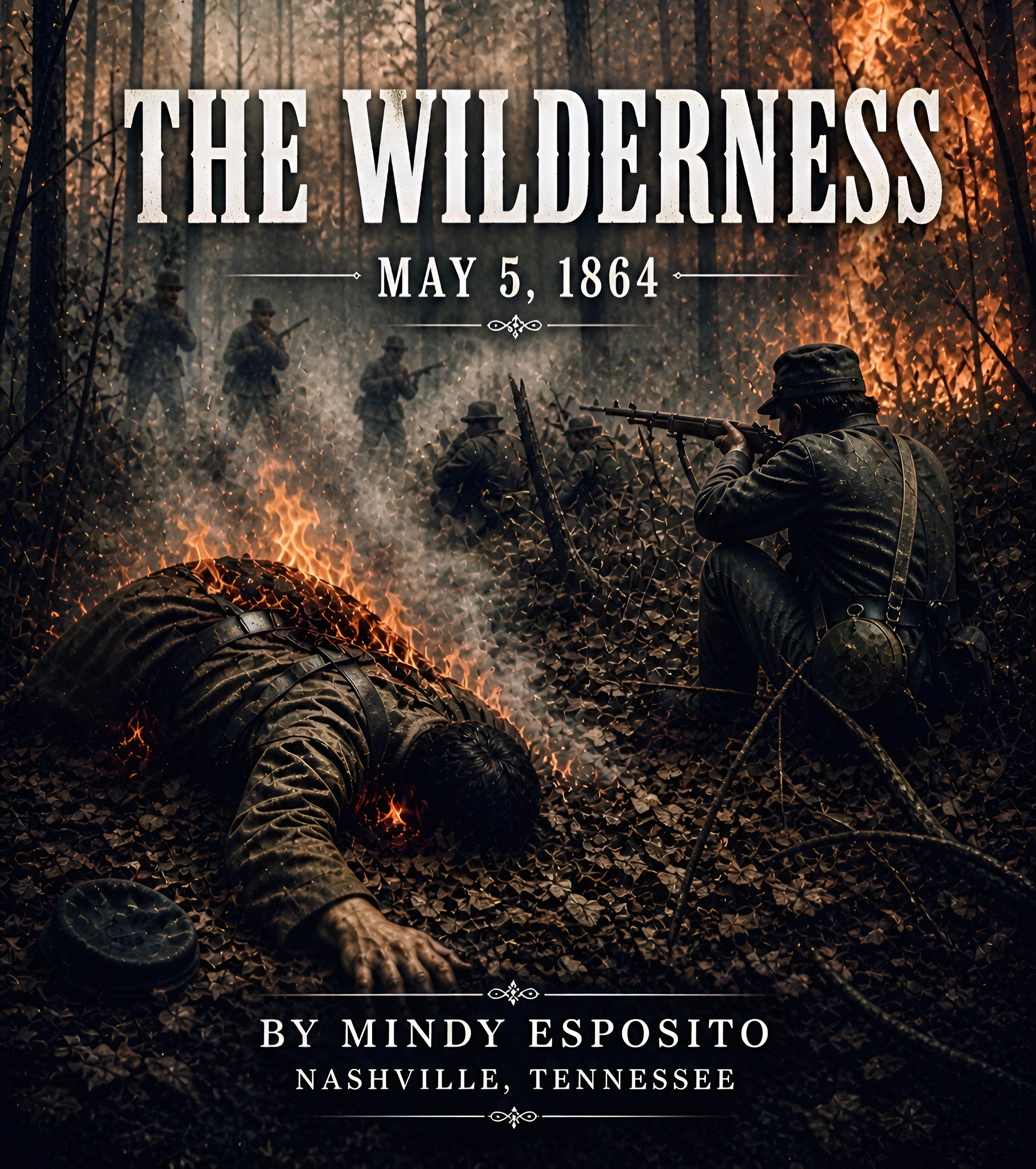
The man next to him was on fire.
Not screaming. Not moving. Just burning, face down in the dry leaves, one arm stretched out toward the turnpike like he had been reaching for something when it happened. The smoke was everywhere. It had been everywhere since noon. A man from Mississippi had stopped looking for his regiment an hour ago because there was no looking. There was only listening. Muzzle flash in the dark wall of scrub oak and cedar. Sound. Direction. Fire back. That was the whole of it. That was the entire war, reduced to something older and simpler than war. You heard it. You answered it. You tried to stay alive.
He had been in this ground before.
Not him specifically. But his army had. The men of the Army of Northern Virginia knew the Wilderness the way a man knows the rooms of his own house in the dark. Robert E. Lee had fought here before, almost exactly one year earlier, against a different Union general with a different army. That time it was Joe Hooker, with 132,000 men and every advantage on paper. Lee sent Stonewall Jackson on a flanking march through these same trees and shattered the Union right before Hooker lost his nerve entirely. The Wilderness had been good to Lee then.¹
He intended to use it again.
This time the man across the Rapidan was different. Ulysses Grant did not behave like the others. He did not come to Virginia to maneuver. He came to kill the Army of Northern Virginia. Not defeat it. Not push it back. Destroy it. He told George Meade before the campaign began that wherever Lee goes, there you will go also.² He wrote into his own plan, in plain language, that casualties on both sides could be high but the Union had the resources to replace them. He meant it as strategy. He meant it as permission.³
The North had four million men of military age. The Confederacy had roughly one million.⁴ Grant understood that arithmetic better than anyone alive. If he could bleed Lee fast enough and long enough, the South would simply run out of men to put in the field. He would lose more soldiers than Lee in every single battle and still win the war. The math was that cold. The strategy was that deliberate.
And on the morning of May 5, 1864, he proved he meant every word of it.
Lee had 61,000 men. Grant had 102,000.⁵ Lee sent Ewell down the Orange Turnpike and A.P. Hill down the Orange Plank Road and told them to hit Grant in the flank before he could clear the timber and reach open ground. Longstreet was a full day's march away. Lee was attacking with two thirds of what he had because waiting was not an option. If Grant got through the Wilderness intact, the road to Richmond was open and the war was effectively over. Lee could not afford to wait for perfect conditions. He never could. So he went with what he had and trusted the ground.
The ground rewarded him. The Union army had numerical superiority that the thicket simply swallowed. They had 316 artillery pieces that could not be deployed. They had battle formations that dissolved within a hundred yards of the tree line. When Warren's Fifth Corps stepped out of the woods and into the open ground of Saunders Field, Ewell's men were already dug in on the high western edge with a clear field of fire.⁶ The Federals walked into it. Of 529 men in one regiment alone, 268 fell in the crossing. Their colonel stood inside his own lines afterward, weeping, unable to locate what remained of his command.⁷
Warren had seen it coming. He told his superiors the ground was wrong, asked to wait until his flanks were covered before attacking. He was overruled. The order from above was to pitch in immediately.⁸ Pitch in. Those were the actual words. Pitch in, regardless of terrain, regardless of preparation, regardless of what the man on the ground was telling them.
That is the Butcher at work.
Grant sat at his headquarters at the Ellwood plantation, smoked his cigars, and sent orders forward. He watched the casualty reports come in and kept going. He had promised Lincoln before the first shot was fired that he would not retreat, whatever the outcome. He kept that promise. When darkness finally stopped the fighting on May 5, the lines were almost exactly where they had been at dawn. Grant had spent thousands of men to gain nothing. His response was to order the attack resumed at four in the morning.
The lines held because the Army of Northern Virginia held them. Outnumbered nearly two to one, with no Longstreet, with fires burning through the undergrowth and wounded men screaming in the brush between the lines, they held the Orange Turnpike and they held the Plank Road through the entire length of that terrible day. Not because the ground made it easy. The ground made everything hard for everyone. They held it because they were the Army of Northern Virginia and Robert E. Lee had chosen this place and these men trusted him with a faith that bordered on something beyond military loyalty.
Private William Wilson of Virginia said it plainly. "No army ever had such a leader as General Lee. No general ever had such an army."⁹
He was right on both counts.
When full darkness settled on the Wilderness on the night of May 5, both armies lay in the smoking timber and listened to the wounded burning between them. The total casualties across both days would reach nearly 29,000, with the Union bearing more than 17,500 of them against roughly 11,000 Confederate.¹⁰ The ground was a draw by any military measure. Neither side had moved. Neither side had broken.
But Grant had not come to the Wilderness to win a battle. He had come to start a process. A process of bleeding the Confederacy to death one engagement at a time, from this ground all the way to the gates of Richmond, however many of his own men it cost, because he had the men to spend and Lee did not.
Abraham Lincoln, watching the casualty lists arrive in Washington, cried out: "My God! My God! Twenty thousand poor souls sent to their final account in one day. I cannot bear it! I cannot bear it!"¹¹
Grant's aide Horace Porter, who watched the whole of it, reached for the only language large enough. "It seems as though Christian men had turned to fiends, and hell itself had usurped the place of earth."¹²
The men of the Army of Northern Virginia who held that ground on May 5, 1864 already knew that. They had spent the whole day proving it.
And Grant ordered the attack for four in the morning.
By Mindy Esposito/ May 5, 2026/ Nashville, Tennessee
ABOUT THE AUTHOR
Mindy Esposito is an independent historian, writer, and advocate with more than 21 years of primary source research experience specializing in 19th and 20th century American history. A ninth-generation American with family roots on both sides of the War Between the States. She is the co-author, with her grandson Noah, of 'Rebel Boys: The War Comes to Tennessee', and the author of the 'The Convenient Lie' She publishes at mespo2006.substack.com.
☆☆☆☆☆
FOOTNOTES
1. The Battle of Chancellorsville, April 30 to May 6, 1863, was fought in the same Wilderness terrain. Hooker commanded 132,000 men against Lee's 61,000. Lee's flank attack under Jackson on May 2 routed the Union XI Corps. Hooker withdrew on May 5 and 6. See Gordon C. Rhea, *The Battle of the Wilderness, May 5-6, 1864* (Baton Rouge: Louisiana State University Press, 1994), 1-15.
2. Ulysses S. Grant, order to George G. Meade, April 1864, as recorded in Horace Porter, *Campaigning with Grant* (New York: Century Co., 1897), 44. Also cited in U.S. War Department, *The War of the Rebellion: A Compilation of the Official Records of the Union and Confederate Armies*, Series 1, Vol. 36, Part 1 (Washington: Government Printing Office, 1891), 13.
3. Grant's strategic plan explicitly acknowledged that Union casualties would be high but that the Union's superior manpower resources could sustain them where the Confederacy could not. See Rhea, *The Battle of the Wilderness*, 19-24. Also Ulysses S. Grant, *Personal Memoirs of U.S. Grant* (New York: Charles L. Webster & Company, 1885), Vol. 2, 116-121.
4. The 1860 census recorded approximately 5.5 million white males in the Confederate states, of whom roughly one million were of military age and available for service. The Union had a white male population of approximately 13.5 million. See James M. McPherson, *Battle Cry of Freedom: The Civil War Era* (New York: Oxford University Press, 1988), 306-307.
5. Forces engaged at the Battle of the Wilderness: Union, 118,700; Confederate, 61,025. See American Battlefield Trust, "The Wilderness Battle Facts and Summary," battlefields.org. Also Rhea, *The Battle of the Wilderness*, Appendix.
6. Ewell's Second Corps halted on the western edge of Saunders Field and constructed earthworks before Warren's attack. See Rhea, *The Battle of the Wilderness*, 174-198. Also American Battlefield Trust, "The Wilderness Battle Facts and Summary."
7. The regiment was the 140th New York Infantry, commanded by Colonel George Ryan. Of 529 men engaged at Saunders Field, 268 became casualties, including nearly all the regiment's officers. See Roy Morris Jr., "Battle of the Wilderness," *Military History* magazine (April 1997), reprinted at historynet.com.
8. Warren's objections to attacking without his flanks secured are documented in the Official Records. Grant's instruction upon learning of Ewell's approach was to "pitch into" the Confederates without delay. See U.S. War Department, *Official Records*, Series 1, Vol. 36, Part 1, 191. Also Rhea, *The Battle of the Wilderness*, 168-173.
9. Private William Wilson, quoted in Roy Morris Jr., "Battle of the Wilderness," *Military History* magazine (April 1997).
10. Total casualties for the two-day Battle of the Wilderness: Union, 17,666; Confederate, approximately 11,033. See Lloyd W. Klein, "What Happened at the May 1864 Battle of the Wilderness," *History is Now Magazine* (April 2024). Also American Battlefield Trust, "The Wilderness Battle Facts and Summary."
11. Lincoln's words are recorded by journalist John Weiss Forney in *Anecdotes of Public Men*, Vol. 2 (New York: Harper & Brothers, 1874), 180-181. Also cited in "Lincoln, Shakespeare, and the Wilderness," *Emerging Civil War* (May 7, 2018), emergingcivilwar.com.
12. Horace Porter, *Campaigning with Grant* (New York: Century Co., 1897), 79-80.
BIBLIOGRAPHY
Primary Sources
Forney, John Weiss. *Anecdotes of Public Men*. Vol. 2. New York: Harper & Brothers, 1874.
Grant, Ulysses S. *Personal Memoirs of U.S. Grant*. 2 vols. New York: Charles L. Webster & Company, 1885.
Porter, Horace. *Campaigning with Grant*. New York: Century Co., 1897.
U.S. War Department. *The War of the Rebellion: A Compilation of the Official Records of the Union and Confederate Armies*. Series 1, Vol. 36, Parts 1-3. Washington: Government Printing Office, 1891.
Secondary Sources
American Battlefield Trust. "The Wilderness Battle Facts and Summary." battlefields.org. Accessed May 2026.
Klein, Lloyd W. "What Happened at the May 1864 Battle of the Wilderness in the US Civil War?" *History is Now Magazine*, April 2024. historyisnowmagazine.com.
Mackowski, Chris. *Hell Itself: The Battle of the Wilderness, May 5-7, 1864*. El Dorado Hills, CA: Savas Beatie, 2016.
McPherson, James M. *Battle Cry of Freedom: The Civil War Era*. New York: Oxford University Press, 1988.
Morris, Roy, Jr. "Battle of the Wilderness." *Military History* magazine, April 1997. Reprinted at historynet.com.
National Park Service. "Ulysses S. Grant's Path to Victory: The 1864 Overland Campaign." nps.gov. Accessed May 2026.
Rhea, Gordon C. *The Battle of the Wilderness, May 5-6, 1864*. Baton Rouge: Louisiana State University Press, 1994.
"Lincoln, Shakespeare, and the Wilderness." *Emerging Civil War*, May 7, 2018. emergingcivilwar.com.
Lee bushwhacked Grant but good. Think it was John Rawlings - Grant’s Aide - that said @ the end of the first day Grant broke down & cried. He’d never seen a “man come so unstrung”. Grant could be rightly considered the American equivalent of Russian General Georgi Zhukov, Josef Stalin’s top pick for battlefield command during World War II. Zhukov would pound German lines repeatedly- regardless of the cost whether it be in men or armored vehicles. He could’ve cared less. When you have an endless supply of manpower you tend to use them profligately.
It is well that war is so terrible, otherwise we should grow too fond of it.
Robert E Lee