THE RIVER SPEAKS
Part Two, Chapter Fourteen

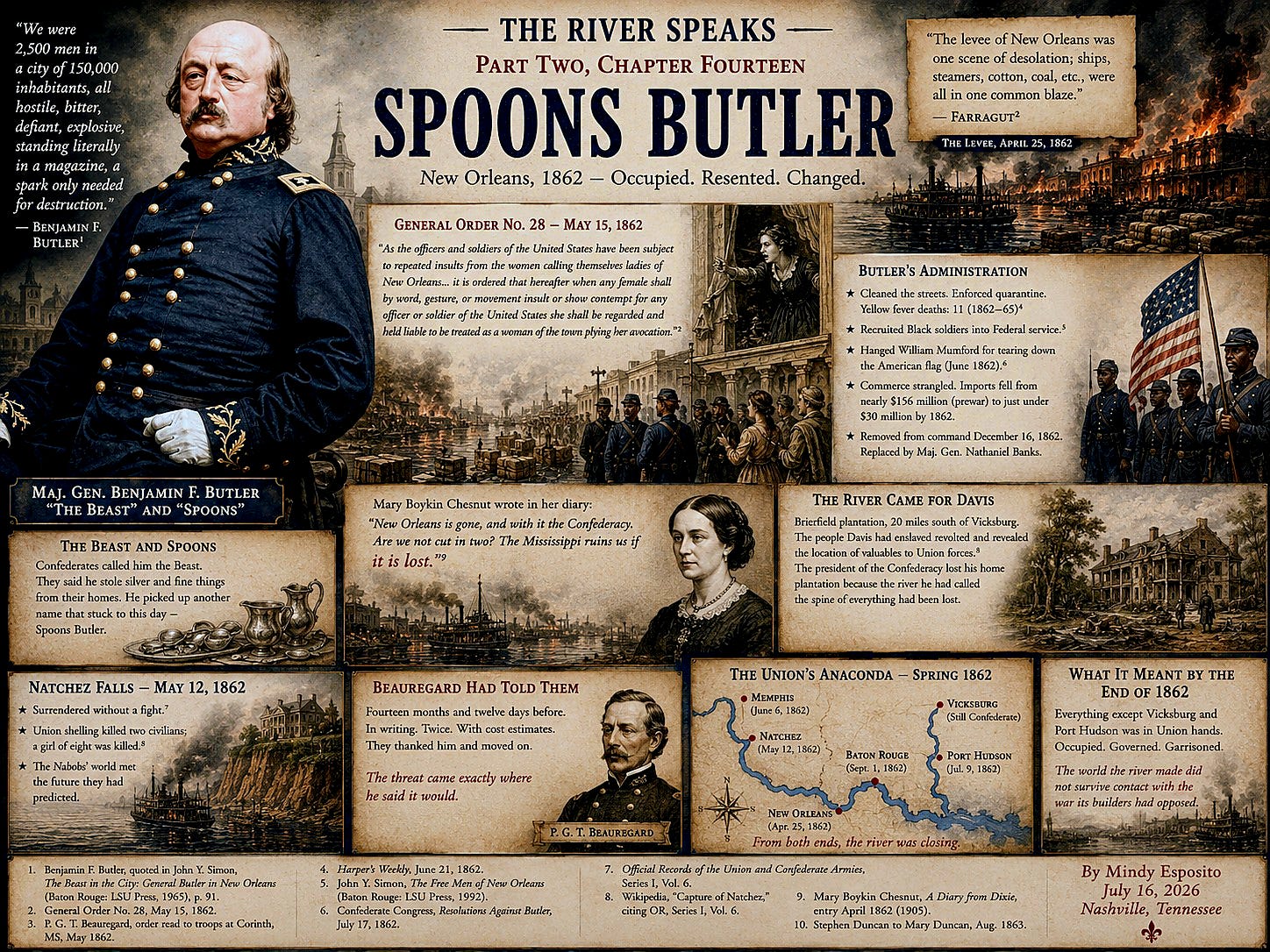
SPOONS BUTLER
The river changed the moment New Orleans fell.
Not slowly. Not gradually. In a single night on April 24th, 1862, the Mississippi River stopped being a Confederate commercial artery and became a Union military highway. The steamboats that had carried cotton south to the Gulf now carried Union soldiers north toward Vicksburg. The levees that had been stacked with bales marked with the names of plantations were burning. The counting houses on Carondelet Street, where 174 cotton factors had moved the wealth of the South to the textile mills of Britain and New England, were now operating in an occupied city under a Federal military government.
Everything the river had made was still there. The mansions. The churches. The markets. The streets.
But the world those things had belonged to was gone.
THE BEAST
On May 1st, 1862, Major General Benjamin Franklin Butler arrived in New Orleans with 2,500 soldiers to govern a city of 150,000 people.
Every one of them hated him.
Butler understood the situation with precision. He wrote: "We were 2,500 men in a city of 150,000 inhabitants, all hostile, bitter, defiant, explosive, standing literally in a magazine, a spark only needed for destruction."¹
He was not wrong about any of it.
The women of New Orleans had decided that since their men were gone to war, they would fight the occupation in the only way available to them. They crossed the street rather than walk near a Union soldier. They left streetcars when Federal officers boarded. They spat on soldiers in the street. One woman emptied a chamber pot on an officer's head from her window above.
Butler's men showed remarkable restraint. He understood that if one of them snapped and struck back, the city could explode.
On May 15th, 1862, he issued General Order No. 28.
*"As the officers and soldiers of the United States have been subject to repeated insults from the women calling themselves ladies of New Orleans in return for the most scrupulous non-interference and courtesy on our part, it is ordered that hereafter when any female shall by word, gesture, or movement insult or show contempt for any officer or soldier of the United States she shall be regarded and held liable to be treated as a woman of the town plying her avocation."*²
The city erupted. The South erupted. The world erupted.
In Britain, Parliament called it a terrible announcement and one of the worst, most brutal, and most unmanly insults to every woman in New Orleans. People across the South printed Butler's portrait on the bottom of chamber pots. Confederate women called him the Beast. The nickname stuck. He would be Beast Butler for the rest of his life and beyond it.
The nickname did not stop there.
Confederate households reported missing silver after Federal searches and billeting swept through their homes. Word spread that Butler himself had pocketed spoons, tableware, and jewelry. No Confederate court had jurisdiction to try him. No Union inquiry ever looked into it. He answered to Washington, and Washington wanted New Orleans held, not investigated.
He picked up a second name. Spoons Butler.
Beast and Spoons. Two nicknames for one general. More than a century and a half later, New Orleans still bristles at his name, and it is Spoons that survived. Ask most people today what they remember about the Union general who occupied New Orleans, if they remember anything at all, and Spoons Butler is the name that comes back. Not Beast. Spoons. That is the name history settled on.
Beauregard, now commanding at Corinth, Mississippi, four hundred miles from New Orleans, ordered General Order No. 28 read aloud to his troops on dress parade. He added his own words to it.
"Men of the South! shall our mothers, our wives, our daughters and our sisters, be thus outraged by the ruffianly soldiers of the North, to whom is given the right to treat, at their pleasure, the ladies of the South as common harlots? Arouse friends, and drive back from our soil, those infamous invaders of our homes and disturbers of our family ties."³
The same Beauregard who had warned about the river in February 1861. The same Beauregard who had just watched Johnston bleed to death at Shiloh. Now using Butler's order to try to recruit soldiers to a cause that had already lost the river at both ends.
Butler's administration had its practical successes, and they were not small ones. New Orleans lost roughly one in ten residents to yellow fever in a typical year before the war. Butler put unemployed men to work cleaning the streets, imposed a strict quarantine, and enforced sanitation measures that New Orleans had never seen before. During the fever season of 1862, the hottest months of late summer into fall when the disease usually did its worst work, only two people died of yellow fever in the entire city. Eleven died across the whole span of the occupation, 1862 through 1865. Harper's Weekly in the North ran a cartoon of Butler holding a soap bucket and scrub brush in front of an approving Lincoln, predicting that yellow fever would prove to be nothing more than the fruit of native dirt.⁴
New Orleans did not believe him and did not thank him. When Federal control ended and the city returned to its old habits, the fever came back with it. One hundred eighty five New Orleanians died of yellow fever the year after the war ended. Three thousand one hundred seven died the year after that.
Butler also began recruiting Black soldiers into Federal service, forming regiments of free men of color and formerly enslaved men who had escaped to Union lines. It was one of the earliest such efforts of the war, and it infuriated the White population of New Orleans more than the chamber pot order had.⁵
In June 1862, he hanged William Mumford for tearing down the American flag over the New Orleans Mint. International outrage followed. The Confederate Congress declared Butler a felon and an outlaw, ordering that if captured he be immediately hanged.⁶
The commerce of New Orleans was strangled. Imports shrank from a prewar value of almost $156 million to just under $30 million by 1862. The cotton factors on Carondelet Street, the men documented in Chapter Six, were now operating under Federal occupation, counting a fraction of the wealth that had once moved through their hands.
On December 16th, 1862, Butler was removed from command. Major General Nathaniel Banks replaced him.
Spoons Butler left New Orleans standing. Occupied, resentful, and changed. But standing.
NATCHEZ
Seventy-two miles south of Vicksburg, the world the Nabobs had built was about to meet the future they had predicted.
On May 12th, 1862, Farragut's fleet reached Natchez. The city surrendered without a fight.⁷
A Union ironclad shelled the town from the river as it approached. Two civilians were killed. An elderly man died of a heart attack in the panic. An eight year old girl named Rosalie Beekman was killed by a shell fragment.⁸
Stephen Duncan of Carlisle, Pennsylvania, and Levin Marshall of Virginia, and Francis Surget, the son of a French sea captain. These men, the wealthiest slaveholders in the country, had opposed secession from the beginning. They were Whiggish and Unionist and outvoted.
Duncan's own position was not a simple one, and the record does not let us pretend otherwise. In the earliest days of the secession crisis he sided with the South and accused the North of trampling on property rights. But as Mississippi moved toward its ordinance of secession in January 1861, he broke from the fire eaters entirely, positioned himself as a conditional Unionist, and warned that leaving the Union would devastate the very planter class it claimed to protect, without any constitutional remedy for the grievances that had caused the split in the first place.⁹
He said do not do this, we will lose. He was overruled.
Now the war had arrived at his front door exactly as he said it would.
The Union occupation force made its headquarters at Rosalie, the Georgian style mansion overlooking the river, the same mansion documented in Chapter Six. The Nabobs watched Federal officers move into their parlors. They watched their commercial networks, built over two generations and stretching to New York and Liverpool, collapse under blockade and occupation. Their cotton had no market. Their steamboats had no destination.
But their houses were standing.
Natchez survived the war almost entirely intact. Its antebellum architecture is preserved to this day. Because the men who built it chose not to fight for a secession they had never wanted, the Union army had no reason to burn what it occupied.
Duncan stayed through most of it, watching the world he had warned about arrive in pieces. He wrote to his daughter Mary in August 1863 about the human cost of the Emancipation Proclamation's blunt reach, noting that its punishments fell three or four times more often on Unionist friends than on the secessionists who had caused the war in the first place, a hard grievance for men who had never wanted disunion at all.¹⁰
In the spring of 1863, Duncan finally left for good. He returned permanently to his home in New York, the same city his cotton profits and his railroad investments had always been tied to. Before he went, he presented the Confederate government with a bill for $185,000 to compensate him for his wartime losses, all of which he attributed to the act of secession.⁷
He had told them. In writing, in votes, in the plainest language available to a man of his standing. They had not listened. He died in New York in January 1867, having outlived the world he tried to save from itself.
Natchez did not fight because Natchez had never wanted this war. And the river, indifferent as always, carried Federal gunboats past its bluffs exactly as its wealthiest citizens had warned it would.
WHAT THE OCCUPATION TELLS US
By the end of 1862, the Confederacy held two things on the Mississippi River. Vicksburg. And Port Hudson.
Everything else, New Orleans, Baton Rouge, Natchez, Memphis, was gone. Occupied. Governed by Union generals. Garrisoned by Union troops. The wealthiest city in the Confederacy was ruled by a man the entire South called the Beast, and remembers today as Spoons. The wealthiest county in America was headquartered out of one of its own mansions by the army it had tried to avoid fighting.
The world the river made, documented in Chapter Six in all its cotton and marble and steamboat glory, did not survive contact with the war its builders had opposed.
What was left was the nail head. Vicksburg. And the last outpost below it. Port Hudson.
The Confederacy had one year left to hold them.
By Mindy Esposito / July 16, 2026 / Nashville, Tennessee
NOTES
1. Benjamin F. Butler to Edwin M. Stanton, May 1862. Official Records of the Union and Confederate Armies, Series I, Volume 15.
2. Benjamin F. Butler, General Order No. 28, May 15, 1862. Official Records of the Union and Confederate Armies, Series I, Volume 15.
3. P.G.T. Beauregard, General Order to the Army of the Mississippi, May 19, 1862. Quoted in Alfred Roman, *Military Operations of General Beauregard*, Vol. 1 (New York: Harper and Brothers, 1884).
4. Ron Coddington, "General Butler and Yellow Fever in New Orleans," *Dead Confederates: A Civil War Era Blog*. Harper's Weekly, 1862, cited therein.
5. American Battlefield Trust, "New Orleans in the Civil War." 64 Parishes, "Fall of New Orleans and Federal Occupation."
6. Chester G. Hearn, *When the Devil Came Down to Dixie: Ben Butler in New Orleans* (Baton Rouge: Louisiana State University Press, 1997).
7. William K. Scarborough, "Natchez Nabobs," *Mississippi Encyclopedia*. Martha Jane Brazy, *An American Planter: Stephen Duncan of Antebellum Natchez and New York* (Baton Rouge: Louisiana State University Press, 2006).
8. Essential Civil War Curriculum, "The Capture of New Orleans and the Mississippi Valley." *History of Natchez, Mississippi.*
9. Grokipedia, "Stephen Duncan," citing Brazy, *An American Planter*. *Mississippi Encyclopedia*, "Duncan, Stephen."
10. Stephen Duncan to Mary Duncan, August 25, 1863, Natchez, Mississippi. Abraham Lincoln Papers, Library of Congress, House Divided Project, Dickinson College.
Hoping for a book version soon.