HE NEVER SURRENDERED
The Iron General: Joseph O. Shelby's Defiance and Honor

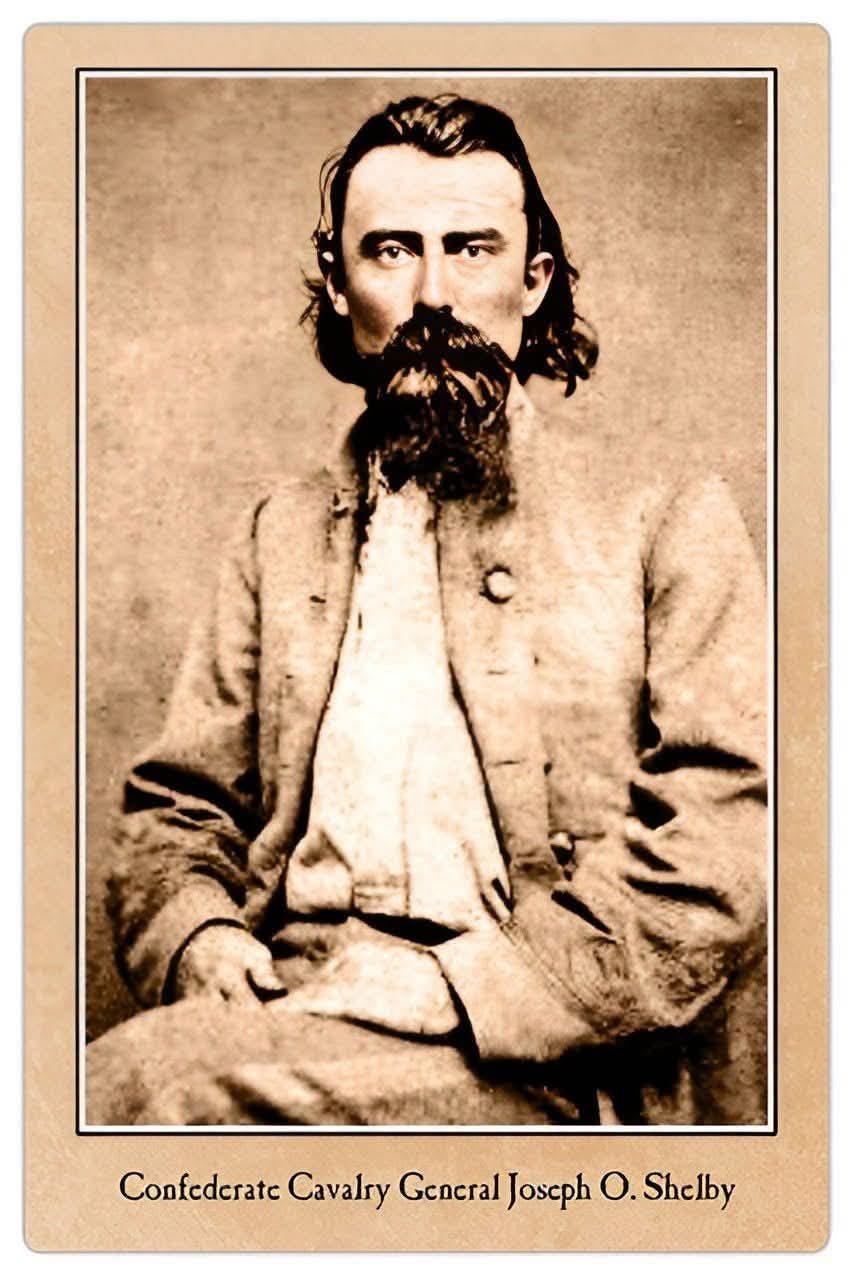
Among the many fierce and devoted sons of the South, few names echo with the same defiant spirit and unyielding resolve as that of General Joseph Orville Shelby. A man forged in the fire of Missouri’s borderland struggles and tested on the blood-soaked fields of war, Shelby embodied the very soul of the Confederate cavalry. His courage, loyalty, and unbreakable sense of honor made him not only a terror to Federal forces but also a symbol of Southern resistance—one that endured even after the guns of war had fallen silent.
Born in Lexington, Kentucky in 1830 and later settling in Missouri, Shelby was no stranger to conflict. Before the Civil War, he had already led men in the bloody Kansas-Missouri border skirmishes. When war broke out in 1861, Shelby threw in his lot with the Confederacy and raised his own cavalry regiment. Quickly proving himself a daring and skilled commander, he gained fame for his lightning raids, bold tactics, and fierce loyalty to his men. He rose through the ranks and ultimately commanded a division under General Sterling Price.
Shelby’s exploits read like something from legend. He led his "Iron Brigade" on a 1,500-mile raid through Missouri in 1863, destroying railroads, capturing towns, and tying down thousands of Union troops. His men were some of the toughest fighters in the Western theater, and his leadership earned him the admiration of allies and the grudging respect of his enemies. General Shelby’s loyalty to the Confederate cause never wavered, and even in defeat, he remained defiant.
When the war ended in 1865, Shelby faced a decision that would define his legacy. While many Southern leaders surrendered and accepted Reconstruction, Shelby refused. He would not yield to a government he believed had subjugated the South through force, nor would he take an oath he could not honorably uphold. Instead, Shelby gathered a band of nearly 600 die-hard Confederates and rode south—not to fight, but to flee to freedom. He crossed the Rio Grande into Mexico, refusing to bow before Union authority. Interestingly, they crossed into Mexico at what is now Shelby Park, in Eagle Pass, Texas.
In Mexico, Shelby and his followers offered their swords to Emperor Maximilian, though they refused to fight against the Mexican people. Maximilian, impressed by Shelby’s honor and discipline, gave him the title of "Imperial Colonel of Cavalry" and allowed the ex-Confederates to establish a colony of sorts. Though the venture was short-lived—Maximilian’s empire soon collapsed—Shelby’s actions showed the world that for some, surrender was not an option. He returned to Missouri in 1867, a man who had never surrendered, never taken the oath, and never compromised his principles.
In the years that followed, Shelby lived a quiet life compared to his wartime exploits. He became a farmer and later served as U.S. Marshal under President Grover Cleveland—an ironic twist for a man who once took up arms against the very government he now served. But even in federal service, Shelby was respected for his integrity, leadership, and unshakable sense of justice.
Joseph Shelby died in 1897 and was buried in Forest Hill Cemetery in Kansas City, Missouri. At his request, the Confederate battle flag was wrapped around him like a shroud, and his sword was laid by his side. He had lived—and died—a man of honor.
To this day, General Joseph O. Shelby remains one of the most admired and unrepentant figures of the Confederacy. He did not surrender. He did not recant. He rode into exile with his men rather than betray the cause he believed was just. His story is not merely one of battle, but of conviction, loyalty, and the unyielding spirit of the South.
M. Esposito 07/29/2025
Excellent bio of a man of honor and principle.
My great great grandfather on my dad's side never surrendered never signed not oath of a elegance back to the US. He saw the end was near and he slipped away and slipped back home to his wife and kids